
My Top 3 Swimming Tools For the Beginner and Struggling Swimmer.
There are a number or swimming accessories available to help you improve your swimming technique, speed and efficiency. But not all swim gear is created equal and not every swimmer will benefit the same from all of the products. Not to mention, it can be less than enjoyable packing like you're going on an adventure race to swim laps for hour at your local pool. Having worked extensively with adult triathletes and beginning swimmers who didn't benefit from learning proper stroke mechanics as a kid, there tends to be common areas that need to be focused on to improve the fundamentals of their swimming form. So that brings us to the short list of three critical items that will help all swimmers struggling with their swim mechanics, and a great starter tool bag for intermediate swimmers looking to make the next leap in their swimming performance.
Triathlon is already a fairly expensive sport, so I've written this list in order of importance. So if you can only get one item at a time, I suggest purchasing in this order.
Number 1: Swimming Fins
 Not all fins are created equal, so if you happen to run across a pair at a yard sale or Craigslist, be sure they are the right style. And notice I said "swimming" fins. Believe it or not there are several styles of fins, but the type that works best for beginners (and triathletes in general) is what's called a Zoomer Fin. This style of fins has a very short, slightly wide blade. The advantage of this style of fin is that it is large enough to help you get a lot more propulsion from your kick, but it's not so large that you don't still need to use your arms to swim efficiently and thus won't overpower your arm stroke. So the idea is to use a fin that helps your stoke, not propel you across the pool in spite of it. I suggest using the fins more if you can't keep your feet up and body line horizontal (ask someone to watch or video you), if your kick is extremely weak, and if you have difficulty maintaining forward moment when taking a breath. As you improve in these areas, alternate swimming sets with and without the fins to help improve your feel for correct body line and speed while breathing.
Number 2: Swimming Snorkel

The most common issue beginning to intermediate level swimmers have with their swim stroke is a breakdown of their form when they take a breathe. So if that's the case, why not make the snorkel the number 1 item on the list? Good question! It's not more important than the fins, because just having the snorkel alone won't improve your body position in the water and the most common form breakdown while breathing is not creating enough forward momentum. The key advantage of the snorkel is the removal of the biggest fear and cause of tension while swimming: The Need To Breathe! Having your face submerged in water can cause you to hold your breathe (instead of exhaling) giving you less time to inhale when you do take a breathe and consequently you slow down to give yourself enough time to do both when you mouth finally reaches the surface. This slowing down almost always results in a break down of your form. The snorkel removes this anxiety (since air is readily available) and the form breaks, allowing you to focus on your stroke mechanics and letting you improving the synchronicity of breathing and your stroke.
Number 3: Swimming Metronome
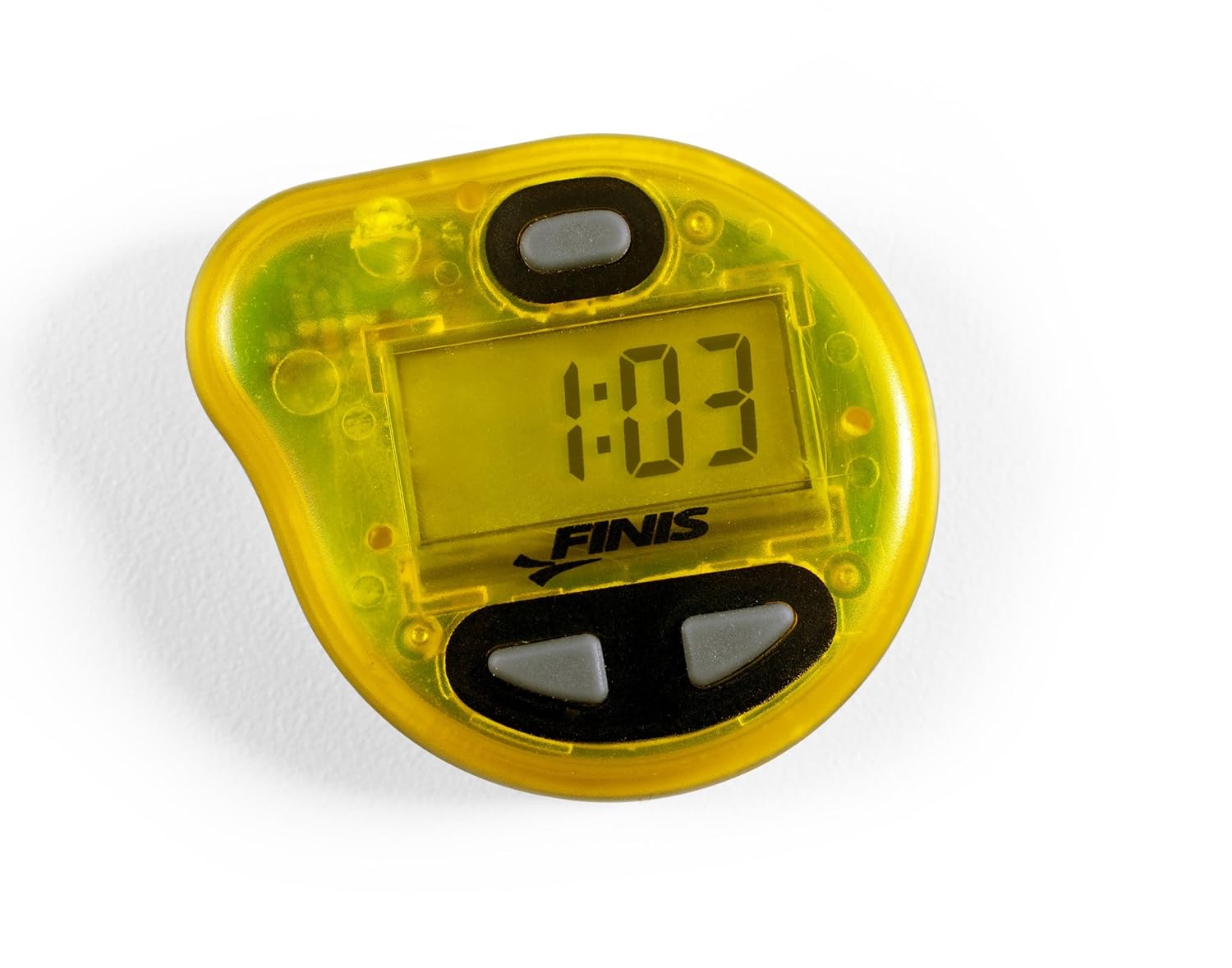 A metronome is a small digital piece of equipment placed under your swim cap or attached to your goggles that provides an audible beep to guide the timing of your swim stroke. This last item is that final piece of the puzzle when you're looking to make those key improvements in your basic stroke technique. Not unlike beginning runners, who train at the same speed no matter what distance they run, swimmers can benefit drastically by changing the intensity and pacing of their workouts. Additionally, finding the optimal stroke rate that result in your fastest and most efficient stroke will rapidly improve your race results and not leave you feeling completely exhausted after the first leg of your triathlon. And not all swimmers are created equal. Just as some cyclist are more effective at a higher cadence (or pedal stroke rate), others perform better at a lower one. The same goes for swimmers. Your body type, muscular strength, and natural stroke type all contribute to determine what stroke rate is optimal for you. Of course you can spend hours and hours trying to modify your stroke style, but that is an uphill battle that won't benefit the beginning to intermediate level swimmer. Using the metronome to test your optimal stroke rate and well as challenge you beyond your comfort zone, it one of the fastest ways to build your swim fitness and improve your stroke efficiency.
HAPPY SWIMMING !!!


